What Is a Turnover in Basketball? Definition, Types, Stats, and How to Reduce Them
Last Updated On: May 13, 2026
NBA teams average between 12 and 15 turnovers per game, and each one is a scoring opportunity handed directly to the opponent. Whether you are a beginner trying to understand the rules or a coach looking to cut costly mistakes, knowing what a turnover is and why it happens is one of the most important fundamentals in the sport.
This guide covers everything: the full definition, the difference between live and dead ball turnovers, every major cause, how turnovers affect the game through fast breaks, how to calculate turnover stats, real NBA examples, and proven ways to reduce them.
What is a Turnover in basketball?
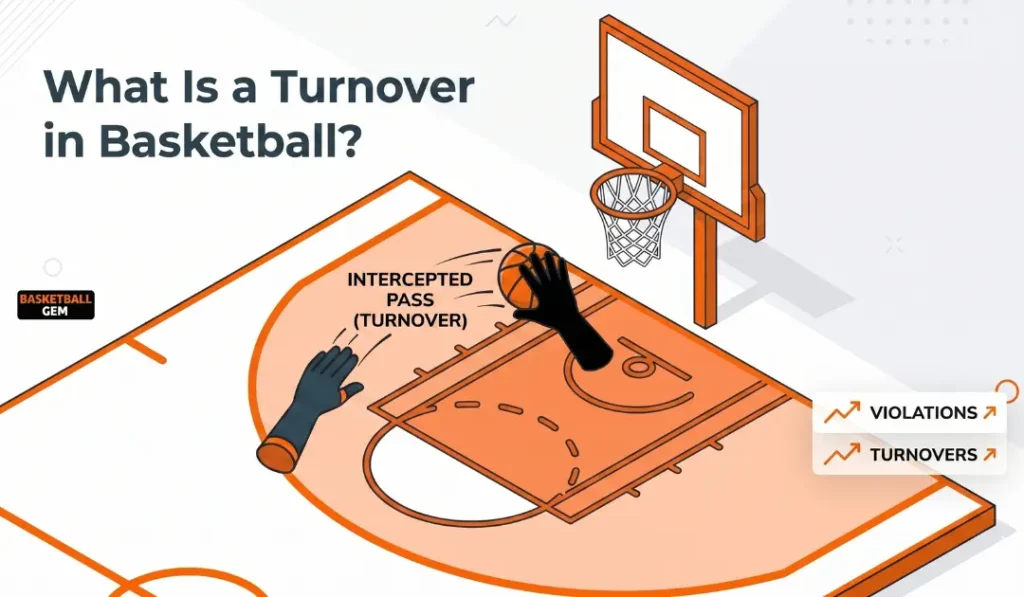
A turnover in basketball occurs when the offensive team loses possession of the ball to the opposing team before any shot attempt is made. It does not matter whether the ball is stolen, fumbled out of bounds, or lost due to a rules violation. As long as possession switches to the defense before a field goal attempt, it counts as a turnover.
The offensive team is then penalized with the loss of possession, and the defense transitions into offense. How quickly that happens depends on the type of turnover committed.
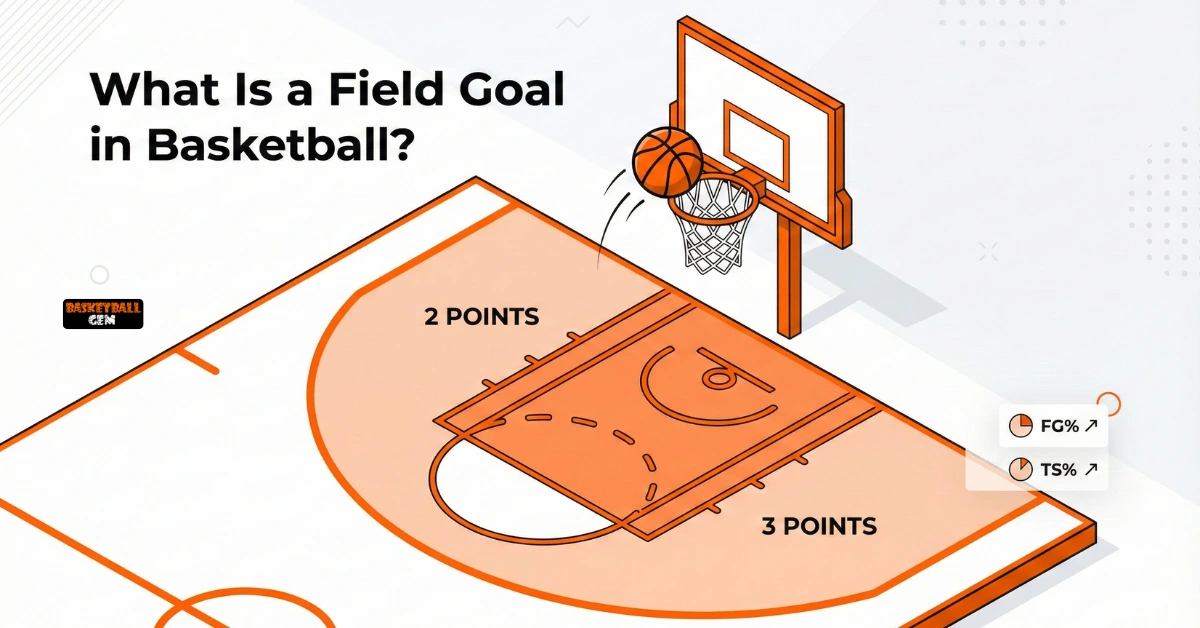
To understand how scoring works once a team regains possession after a turnover, you can read our guide on what is a field goal in basketball.
Live Ball Turnovers vs Dead Ball Turnovers
Not all turnovers carry the same level of danger for the team that commits them. There are two distinct categories, and understanding the difference explains why coaches treat them so differently.
Live ball turnovers happen when the defense gains immediate possession without the referee stopping play. A stolen pass, a ball stripped from a dribbler, or an intercepted throw-in are classic examples. Because there is no stoppage, the defensive team can sprint directly into transition offense and attack before the opposing defense has any time to set up. These turnovers frequently lead to easy layups and fast break points, and they can completely shift the momentum of a game in a matter of seconds.
Dead ball turnovers result from rules violations such as traveling, double dribble, three-second violations, or an offensive foul. The referee blows the whistle, play stops, and the other team receives the ball out of bounds at or near the spot of the violation. Because there is a pause in play, the previous offensive team has time to get back on defense and prevent an immediate fast break opportunity. Dead ball turnovers are still costly, but they are considerably less dangerous than live ball turnovers.
Coaches universally fear live ball turnovers far more, which is why protecting the ball during passing and dribbling situations is drilled into players at every level.
How Do Turnovers Happen? The Main Causes
Turnovers occur in two broad ways: through violations called by the referee, and through physical mistakes made by offensive players.
Violations That Cause Turnovers
A violation is a rules infraction that causes the referee to stop play and award the ball to the opposing team. Common violations that result in turnovers include:
Traveling happens when a player takes too many steps without dribbling the ball. Under NBA rules, a player may take two steps after gathering the ball, but a third step without releasing the ball is a travel and results in a dead ball turnover.
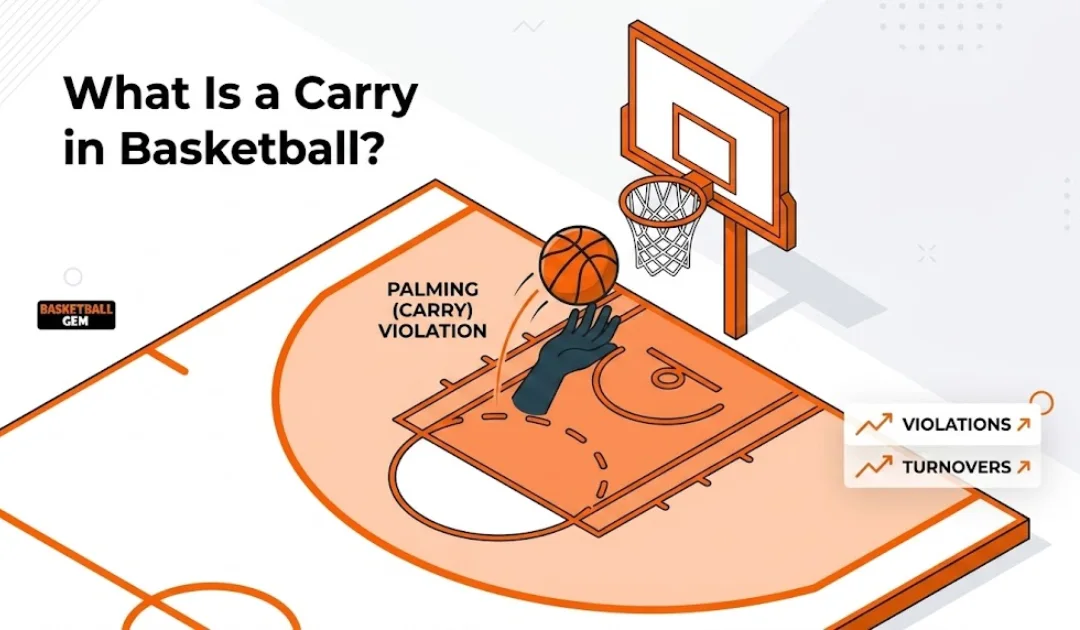
Double dribble occurs when a player dribbles with both hands simultaneously or picks up the dribble and then starts dribbling again. Once a player stops dribbling they must either pass or shoot. Restarting the dribble is an immediate violation. You can learn more about this in our detailed breakdown of what is a carry in basketball.
Carrying or palming is a close relative of the double dribble and occurs when a player cups the ball from underneath during a dribble, effectively carrying it while moving. This stops the dribble without the player realizing it and leads to a turnover when called.
Three-second violation applies to offensive players who remain inside the lane, also called the paint, for more than three consecutive seconds without making a move toward the basket.
Five-second violation is called when a player who is being closely guarded fails to pass, dribble, or shoot the ball within five seconds. It is also applied during inbound passes when the thrower takes more than five seconds to release the ball.
Shot clock violation occurs when a team fails to attempt a field goal within the 24-second shot clock window in the NBA. The ball is turned over to the other team at the nearest sideline.
Backcourt violation happens when an offensive player who has already advanced the ball past the half-court line dribbles or passes the ball back into the backcourt. That same player or a teammate cannot be the first to touch the ball in the backcourt.
Out of bounds is called when a player with possession steps on or over the boundary line. The ball is immediately turned over to the opposing team.
Illegal screen results in an offensive foul when a player setting a screen makes prohibited contact with a defender or fails to give the defender space to avoid the screen.
Player Errors That Cause Turnovers
Beyond violations, turnovers also happen simply because offensive players make mistakes under defensive pressure.
A stolen ball occurs when a defender legally takes the ball from a dribbling player or knocks it away before picking it up. Defenders who read passing lanes well and apply aggressive on-ball pressure create the conditions for steals.
A pass interception happens when a defender steps into a passing lane and catches the ball before it reaches its intended target. Players who telegraph their passes by staring at a receiver give defenders a clear cue to jump the lane.
An offensive foul such as charging, where an offensive player runs into a stationary defender, also results in a turnover. The ball is awarded to the defense out of bounds.
Fumbles and dropped balls happen when a player loses control of a loose ball, a rebound, or a difficult catch. These are classified as live ball turnovers if the defense recovers possession without a whistle.
Types of Turnovers in Basketball
All turnovers can also be grouped into two types based on what caused them:
Forced turnovers are those directly created by the defense through active, physical pressure. Steals, interceptions, and charging calls caused by a defender holding position are all forced turnovers. They reflect strong defensive play and are largely credited to the defensive player who made the play happen. Forced turnovers lead to live ball situations and are the most dangerous type for the team that commits them.
Unforced turnovers are self-inflicted mistakes with little or no pressure from the defense. Traveling, stepping out of bounds, double dribbling, or throwing a pass out of the blue with no defender in range are examples. These turnovers come down to concentration, decision-making, and individual skill. They are also the most preventable, which is why coaches focus heavily on eliminating them in practice.
How Turnovers Impact the Game: The Fast Break Effect
The real damage a turnover causes goes beyond just losing possession. When a team commits a live ball turnover, it instantly becomes vulnerable to a fast break.
A fast break is when the new offensive team pushes the ball up the court quickly before the previous offense can transition back into defensive positions. A stolen pass in the backcourt, for example, leaves multiple defenders caught out of position and facing a numbers disadvantage, often a two-on-one or three-on-two situation. In those scenarios, the attacking team has a very high probability of scoring an uncontested layup or open jump shot.
Research consistently shows that fast break points generated from turnovers are among the highest-efficiency scoring opportunities in basketball. A possession that was supposed to generate points for one team ends up generating points for the other team, effectively creating a swing of four or more points in a single sequence.
This is why coaches treat high-turnover games as one of the most damaging statistical indicators of poor performance. It is not just about the lost shot attempt. It is about the free scoring opportunity given to the other team on the other end of the floor.
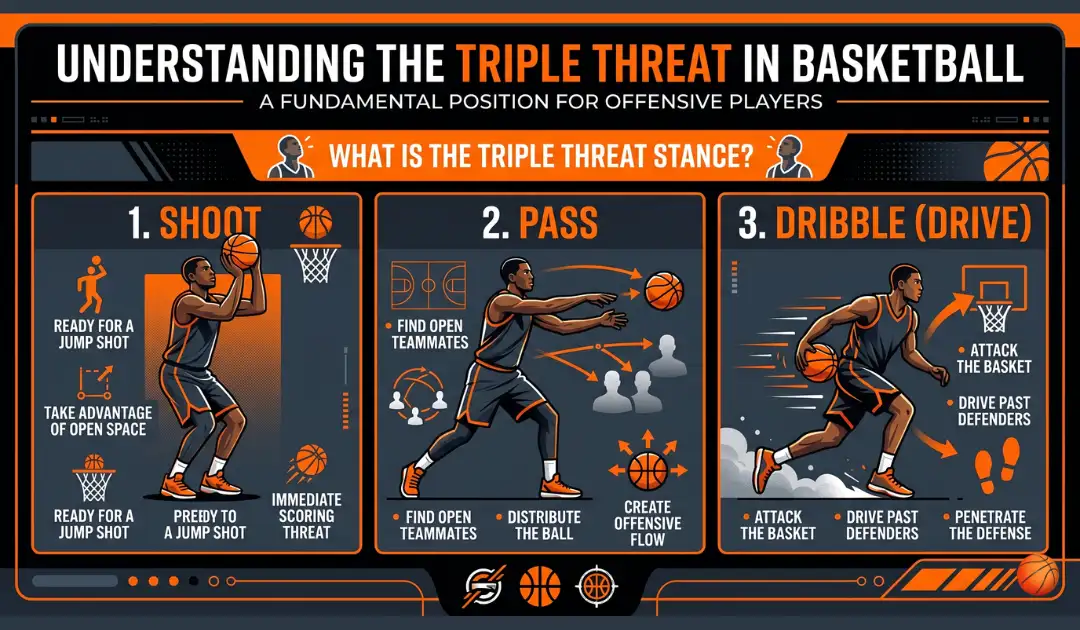
To understand how a triple threat position helps players protect the ball and avoid these live ball situations, check out our complete guide.
NBA Turnover Records and Real-World Examples
Tracking how elite players and teams have handled turnovers throughout history helps put the statistic in proper context.
According to Wikipedia’s turnover records, LeBron James holds the all-time NBA career record with over 5,600 regular-season turnovers. This number is so high largely because James has played more NBA games than nearly any player in history while handling the ball at an elite volume as a playmaker and scorer. More touches over more games naturally produces more turnovers, which is why raw turnover totals are always viewed alongside usage rate when evaluating a player.
The single-game record for most turnovers is 14, shared by Jason Kidd against the New York Knicks on November 17, 2000, and John Drew against the New Jersey Nets on March 1, 1978. James Harden holds the playoff single-game record with 13 turnovers against the Golden State Warriors in May 2015.
On the team side, the 2024-25 Oklahoma City Thunder demonstrated what minimizing turnovers can do for a franchise. According to NBA.com, the Thunder committed 5.3 fewer turnovers per game than their opponents, the best turnover differential recorded in 37 years, and they finished with the best point differential in NBA history during that season. Their discipline with the ball was a core reason for their dominance.
Turnovers have been an official NBA statistic since the 1977-78 season, with the ABA having tracked them a decade earlier beginning in 1967-68.
What Is Turnover Percentage in Basketball?
Turnover percentage, abbreviated as TOV%, is an advanced metric that estimates how often a team or player turns the ball over on every 100 possessions. It is a more accurate measure of turnover frequency than the raw count because it adjusts for the pace of the game and how many offensive opportunities a player creates.
How to Calculate Turnover Percentage
The formula used by Basketball Reference and NBA statisticians is:
TOV% = 100 × TOV ÷ (FGA + 0.44 × FTA + TOV)
Where TOV is turnovers, FGA is field goal attempts, and FTA is free throw attempts. The 0.44 multiplier on free throw attempts accounts for the fact that not every trip to the free throw line constitutes a full possession.
What Is a Good Turnover Percentage?
For individual players, a TOV% below 10 is generally considered excellent. Most productive NBA ball-handlers sit in the 12 to 16 percent range. A TOV% above 20 is a red flag that suggests a player is creating turnovers at a pace that undermines their scoring and playmaking contributions.
For teams, a lower TOV% relative to the league average is directly associated with winning. Teams that consistently rank in the bottom third of the league for opponent-forced turnovers tend to allow more transition points and finish below .500.
|
Turnovers Per Game |
Estimated Points Surrendered |
|---|---|
|
5 to 9 |
5 to 8 |
|
10 to 14 |
8 to 16 |
|
15 to 19 |
12 to 22 |
|
20 to 24 |
16 to 26 |
|
25 or more |
20 or more |
What Is the Assist to Turnover Ratio?
The assist to turnover ratio (AST/TOV) is a widely used metric to evaluate a player’s ball-handling efficiency and decision-making. It measures how many assists a player generates for every turnover they commit. A higher ratio means the player is creating more scoring opportunities than they are giving away.
How to Calculate Assist to Turnover Ratio
AST/TOV = Total Assists ÷ Total Turnovers
If a point guard records 8 assists and 4 turnovers in a game, their ratio is 2.0 for that game.
What Is a Good Assist to Turnover Ratio?
A ratio of 2:1 is the widely accepted standard for a productive ball-handler at any level. It means for every turnover committed, the player is generating two scoring opportunities for teammates. Elite point guards at the NBA level regularly post ratios of 3:1 or higher over a full season.
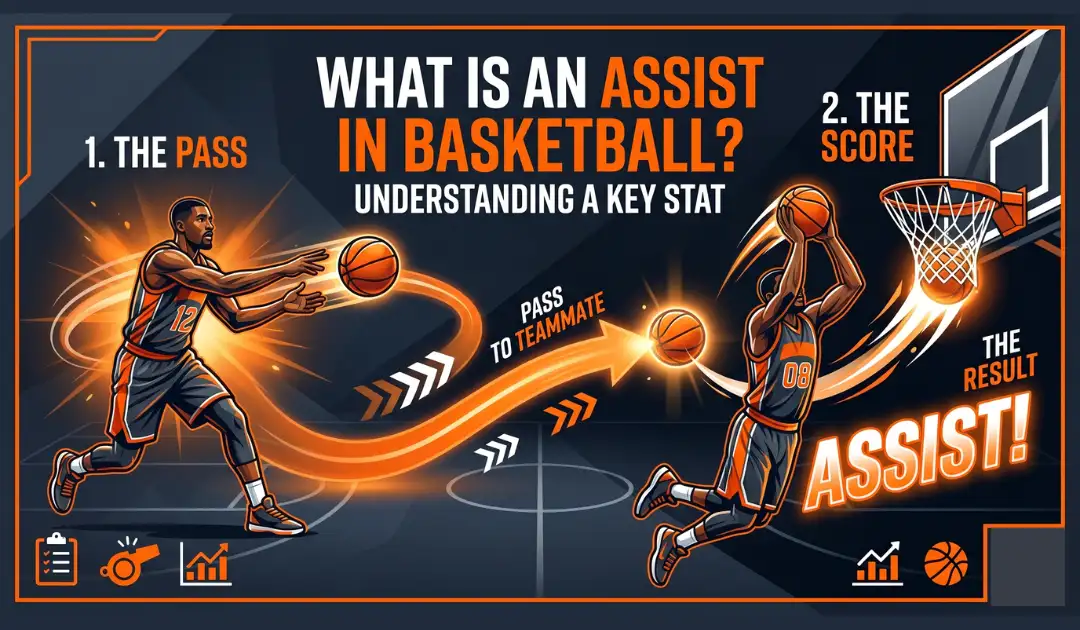
For a deeper look at how assists are awarded and what counts as an official assist across leagues, check out our guide on what is an assist in basketball.
How to Reduce Turnovers in Basketball
Every coach wants fewer turnovers, but reducing them requires addressing specific habits and building skills that hold up under defensive pressure.
Work on ball-handling with a live defender. Stationary dribbling drills build the foundation, but they do not replicate game conditions. Players need to dribble against an active defender who is applying pressure, reaching in, and trying to cut off driving lanes. One-on-one drills are the most direct way to expose and fix weak ball-handling tendencies. Developing the non-dominant hand is especially important because defenders who know a player only goes right will shade accordingly and force the exact situations that produce turnovers.
Practice live passing drills. Throwing passes at a stationary target in practice is very different from delivering a pass under pressure with a defender in the lane. Run passing drills that include a live defender who can step into passing lanes, mirror the passer’s eyes, and apply physical pressure. Players naturally learn pass fakes and timing when there is a real consequence for telegraphing the ball.
Use overloaded drills. One of the most effective coaching tools for reducing turnovers is placing the offense against a defense with one extra player. This constant overload forces offensive players to move sharply, make quick but accurate decisions, and use the dribble only when it genuinely improves a passing angle. Because there is always someone unguarded on defense, the offense cannot afford to be careless. Games feel easier by comparison.
Identify the root cause of individual turnovers. Not all turnovers come from the same source. Some players turn the ball over in pick-and-roll situations. Others lose it in traffic near the baseline. Reviewing game film to identify when and where a specific player’s turnovers happen makes corrective practice far more targeted and efficient.
Improve communication and spacing. Many turnovers at the team level happen because offensive players occupy the same areas of the floor, eliminating clean passing lanes. Proper spacing and verbal communication between teammates about screens, cuts, and defensive positioning directly reduces the kind of congestion that forces bad passes.
Stay calm under defensive pressure. Mental composure under a full-court press or a blitz defense is a skill that has to be trained deliberately. Running pressure defense scrimmages in practice, where the defense is intentionally disruptive and physical, conditions players to stay calm, use their footwork, and make safe decisions rather than panicking and throwing a hopeful pass.
Why Do Teams Record Turnovers?
Turnovers became an official NBA statistic with the 1977-78 season, though the American Basketball Association had already tracked them from its inaugural 1967-68 season. Before that, turnovers were tracked at the team level starting in the 1973-74 NBA season, but not attributed to individual players.
Today, turnovers are recorded in every major professional and amateur basketball league as a standard performance benchmark. Analysts use turnover data to evaluate both individual players and entire systems. A team that consistently ranks in the top tier for low turnovers is generally a well-coached, disciplined squad. A team that consistently ranks near the bottom is typically one that opponents expose with aggressive defensive schemes.
Turnover statistics are also used in contract negotiations, draft evaluations, and in-game strategy. A player with a poor assist to turnover ratio who handles the ball frequently is a tactical liability regardless of their scoring numbers.
Final Thoughts
Turnovers are one of the most direct and measurable ways a basketball team gives away points and momentum. A live ball turnover does not just stop one offensive possession. It creates a high-percentage scoring opportunity for the other team on the very next one. Over the course of a game, teams that consistently out-protect the ball and force more turnovers than they commit have a massive structural advantage.
The good news is that most turnovers, especially unforced ones, are correctable with focused practice. Working on live-situation ball-handling, making deliberate passing decisions under pressure, and reviewing film to understand when and where turnovers happen most frequently gives both players and coaches a clear path to improvement.
Understanding the nuances of possession-based statistics like TOV% and the assist to turnover ratio also helps fans appreciate why certain teams win more games than their raw talent suggests they should.
Frequently Asked Questions
What is a turnover in basketball?
A turnover occurs when the offensive team loses possession of the ball to the opposing team before any shot attempt is made. It can happen through a violation called by the referee, a physical mistake such as a dropped ball or bad pass, or a defensive steal.
What is the difference between a live ball and a dead ball turnover?
A live ball turnover happens without any stoppage in play, such as a stolen pass or an interception. The defense immediately has possession and can push into a fast break. A dead ball turnover results from a rules violation where the referee blows the whistle, stops play, and awards the ball to the defense out of bounds.
What is the difference between a steal and a turnover?
A steal is credited to the defensive player who legally takes or intercepts the ball from the offensive player. A turnover is credited to the offensive player who lost the ball. Every steal produces a turnover, but not every turnover produces a steal. Turnovers from violations, for example, do not involve a steal.
Does a block count as a turnover?
No. A blocked shot is a defensive rejection of a field goal attempt and is tracked separately. A turnover only occurs before a shot is attempted. If the ball is blocked during a shot attempt, the shot attempt itself has already been made, so it does not qualify as a turnover.
Who has the most career turnovers in NBA history?
LeBron James holds the NBA career record for most regular season turnovers with over 5,600, according to Wikipedia. This is largely a reflection of his extraordinary longevity and the high volume of ball-handling he has done over more than two decades in the league.
What is a good number of turnovers per game for a team?
At the NBA level, teams that commit 12 or fewer turnovers per game are generally considered disciplined. The league average has historically sat between 13 and 15. Teams that consistently turn the ball over 17 or more times per game typically struggle to win close games because of the scoring opportunities they generate for opponents.
How many turnovers is too many for an individual player?
Context matters. A point guard who handles the ball for 35 minutes per game will naturally have a higher raw turnover count than a wing who plays off the ball. A TOV% above 18 to 20 percent over a full season is generally considered a concern for a primary ball-handler.
Are turnovers recorded in all basketball leagues?
Yes. Turnovers are tracked in the NBA, WNBA, NCAA, FIBA competitions, and most organized youth and high school leagues. The NBA began recording individual turnovers in 1977-78, and the stat has been a universal benchmark across the sport ever since.
What is a team turnover in basketball?
A team turnover is a turnover that is not attributed to any individual player. It happens in situations such as when a shot clock violation occurs before any player has clear possession, or when a team commits a delay of game infraction. The turnover is counted in the team’s total but does not appear on any player’s individual stat line.
Does a bad shot count as a turnover?
No. If a shot is attempted, even a poor one, it is recorded as a field goal attempt and goes on the box score as a missed shot, not a turnover. A turnover only happens when possession is lost before any shot attempt is made.