What Is an Assist in Basketball? NBA, NCAA, FIBA and WNBA Rules Explained
Last Updated On: May 14, 2026
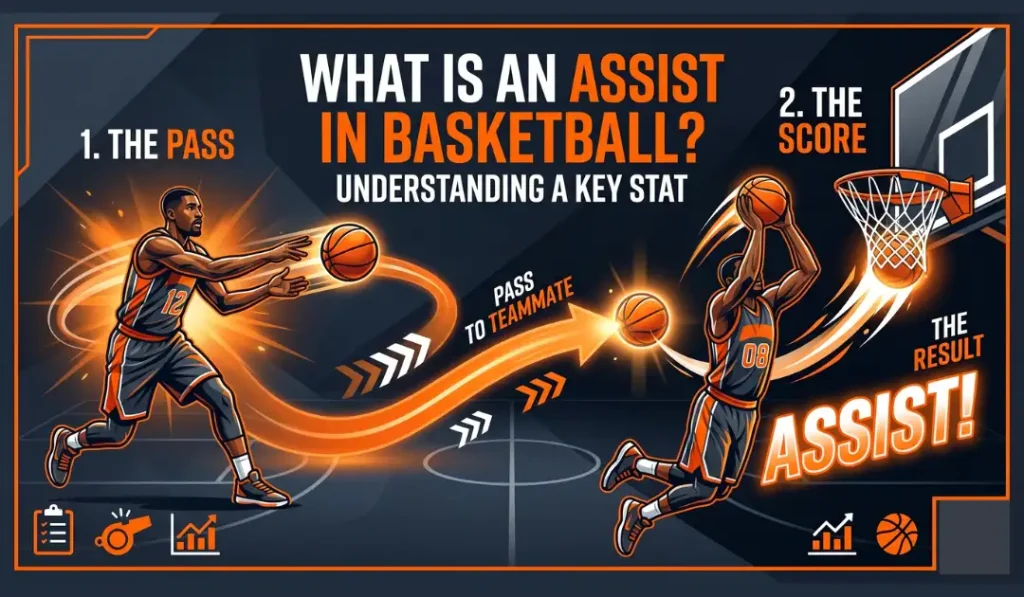
An assist in basketball is a pass that directly leads to a teammate scoring a field goal. It is credited by the official scorer based on judgment, and only the final pass before the made basket counts. Statisticians use judgment on close calls, but the general idea is that the pass clearly sets up the score rather than just moving the ball around.
You will see assists listed in the box score as AST alongside points and rebounds. They are one of the main ways to measure how much a player helps their teammates get good scoring opportunities.
Basketball celebrates scorers. But anyone who has watched the game closely knows that the pass setting up the bucket is often just as impressive as the bucket itself. Magic Johnson, John Stockton, Steve Nash, the greatest playmakers in history built their legacies not on how many points they scored, but on how often they put teammates in position to score. That creative, selfless pass has a name in the record books: the assist.
Whether you are new to the game or simply looking for clarity on exactly how assists are counted, ruled, and tracked across different leagues, this guide covers everything you need to know. We will walk through the official definition, what counts and what does not, how the rules differ between the NBA, NCAA, FIBA, and WNBA, the all-time records, current season leaders, and how assists factor into fantasy basketball.
What is an Assist in Basketball?
According to the NBA’s official definition, an assist is:
“A pass that directly leads to a basket. This can be a pass to the low post that leads to a direct score, a long pass for a layup, a fast-break pass to a teammate for a layup, and/or a pass that results in an open perimeter shot for a teammate. An assist is awarded only if, in the judgment of the statistician, the last player’s pass contributed directly to a made basket. An assist can be awarded for a basket scored after the ball has been dribbled if the player’s pass led to the field goal being made.”
Put simply, when Player A passes the ball and Player B scores directly because of that pass, Player A earns an assist. The statistic is abbreviated as AST in box scores across every level of basketball.
The word “judgment” in that definition is important. Unlike points or rebounds, assists involve a human decision. Official scorers at each venue apply the standard as they see fit, which is why assist totals can vary slightly depending on who is keeping the book on a given night.
What Counts as an Assist? Key Requirements
Understanding what constitutes an assist in basketball means knowing the exact criteria scorers use. There are three main things they look for.
What Does NOT Count as an Assist?
Just as important as knowing what earns an assist is knowing what does not.
NBA vs NCAA vs FIBA vs WNBA: How Assist Rules Differ
The core definition of an assist is the same everywhere, but the specific rules vary meaningfully across leagues. This table summarizes the key differences:
|
Rule |
NBA |
NCAA |
FIBA |
WNBA |
|---|---|---|---|---|
|
Free throw assists |
No |
No |
Yes (if at least one free throw is made) |
No |
|
Dribble limit |
No fixed limit; scorer’s judgment |
No fixed limit; scorer’s judgment |
No fixed limit; scorer’s judgment |
No fixed limit; scorer’s judgment |
|
Inbound passes |
Eligible |
Eligible |
Eligible |
Eligible |
|
Multiple assists per basket |
No (one only) |
No (one only) |
No (one only) |
No (one only) |
|
Who records the stat |
Official scorer at the arena |
Home statistician or appointed scorer |
Official scorer |
Official scorer |
|
Scoring subjectivity |
High — varies by scorer |
High — varies by scorer |
Moderate |
Moderate |
The most meaningful difference is the FIBA free throw rule. In international play, including the Olympics, if a player passes to a teammate who is then fouled in the act of shooting and makes at least one of the resulting free throws, the passer is credited with an assist. The NBA and NCAA do not allow this.
The NCAA also gives home statisticians slightly more discretion, which has historically led to home teams receiving more charitable assist counts in college games.
Types of Assists
Primary Assist (Standard Assist)
This is the assist everyone refers to in everyday conversation. The player who makes the final pass before a made field goal receives the primary assist. It is the number that appears in every box score.
Secondary Assist (Hockey Assist)
A secondary assist, sometimes called a hockey assist by fans who borrow the term from ice hockey, is awarded to the player who passed the ball to the player who then recorded the primary assist — all within one second and without an additional dribble. For example, if Player A passes to Player B, who immediately passes to Player C for a basket, Player A earns the secondary assist and Player B earns the primary assist.
Secondary assists are not counted in official NBA or NCAA box scores. They do appear in NBA advanced tracking data as a way to measure playmaking one layer deeper than traditional assists. During the 2023-24 season, Ja Morant, Tyrese Maxey, and Luka Dončić each averaged 1.3 secondary assists per game, ranking among the league’s best playmakers at that level.
Potential Assist
The NBA tracks potential assists as an advanced metric. The league defines a potential assist as any pass to a teammate who shoots within one dribble of receiving the ball, whether or not the shot goes in. While traditional assists require a made basket, potential assists count every shot attempt that was directly created by a teammate’s pass.
If a player averages significantly more potential assists than actual assists, it often signals that his teammates are missing the shots he is creating. During the 2023-24 season, the leaders in potential assists per game were:
- Trae Young — 18.2
- Tyrese Haliburton — 17.8
- Luka Dončić — 16.9
- Ja Morant — 15.8
- Nikola Jokić — 14.9
These numbers reveal how often elite playmakers are generating quality looks for teammates, independent of whether those teammates convert.
Why Are Assists Important?
Assists matter because they are the most direct measure of unselfishness and ball movement on a basketball team. Teams that produce a high number of assisted field goals tend to spread the ball around effectively, attack defenses from multiple angles, and generate higher-percentage shots for more players.
A useful benchmark: if a team is assisting on more than 60 percent of its made field goals, it is generally considered a well-organized offensive unit. The Golden State Warriors dynasty teams regularly exceeded that threshold, which was one reason their offense was historically difficult to stop.
From a player evaluation standpoint, a high assist total paired with a high scoring average is a rare combination that often identifies the most complete offensive players in the game. LeBron James, Luka Dončić, and Nikola Jokić all rank among the league’s elite because they score and facilitate at a level most players cannot match.
Assists also serve as a proxy for court vision and decision-making. A player who consistently finds the open teammate rather than forcing his own shot is a player coaches can trust to run an offense, which is why high assist averages are often associated with high salaries and leadership roles.
Which Positions Get the Most Assists?
Point Guards
Point guards lead every team in assists at virtually every level of basketball, from youth leagues through the NBA. Their primary role is to initiate the offense, push the ball in transition, and find open teammates in the half court. They handle the ball on almost every possession, giving them far more opportunities to make assist-eligible passes than anyone else on the floor.
In the 2023-24 NBA season, point guards occupied six of the top ten spots in assists per game. The nature of the position — constant ball handling, reading defenses, triggering plays — makes high assist production a baseline expectation for any starting point guard.
Other Positions
While point guards dominate the assist leaderboards, other positions contribute meaningfully. Shooting guards and small forwards who handle the ball in creation roles can rack up assists when their teams run through them. Post players, particularly centers with strong passing ability, can also be prolific assisters.
Nikola Jokić of the Denver Nuggets is the best modern example. As a center, he averaged 9.0 assists per game in 2023-24, a number that would lead most NBA teams in the point guard position. His ability to pass from the high post and the elbow area makes him one of the most unique playmakers in the history of the game. Wilt Chamberlain famously led the entire NBA in assists in the 1967-68 season — another reminder that great passers can come from any position.
NBA All-Time Assist Leaders
The gap between the all-time leader and everyone else in NBA history is astonishing. Here are the top 10 career assist leaders as of the end of the 2025-26 season:
|
Rank |
Player |
Career Assists |
|---|---|---|
|
1 |
John Stockton |
15,806 |
|
2 |
Chris Paul |
12,552 |
|
3 |
Jason Kidd |
12,091 |
|
4 |
LeBron James |
12,016 |
|
5 |
Russell Westbrook |
10,351 |
|
6 |
Steve Nash |
10,335 |
|
7 |
Mark Jackson |
10,334 |
|
8 |
Magic Johnson |
10,141 |
|
9 |
Oscar Robertson |
9,887 |
|
10 |
Isiah Thomas |
9,061 |
John Stockton’s 15,806 career assists represent one of the most untouchable records in professional sports. The gap between Stockton and runner-up Chris Paul is 3,254 assists — roughly equivalent to the gap between Kidd at number two and Andre Miller at number twelve on the all-time list. Stockton also holds the single-season record for assists per game at 14.5, set during the 1989-90 season.
For single-game records, Scott Skiles of the Orlando Magic set the NBA record with 30 assists on December 30, 1990. The team record belongs to the Milwaukee Bucks, who recorded 53 assists in a single game on December 26, 1978.
Magic Johnson holds the highest career assists-per-game average in NBA history at 11.2 per game, a reflection of both his elite passing ability and his longevity at an elite level.
Current NBA Assist Leaders
During the 2025-26 NBA postseason, the top five players in assists were:
- Nikola Jokic (Denver Nuggets) — 9.5 AST
- Scottie Barnes (Toronto Raptors) — 8.6 AST
- Cade Cunningham (Detroit Pistons) — 7.5 AST
- LeBron James (Los Angeles Lakers) — 7.3 AST
- Jrue Holiday (Portland Trail Blazers) — 7.2 AST
Assist to Turnover Ratio Explained
The assist to turnover ratio, often written as AST/TO, measures how efficiently a player generates assists compared to how often they lose the ball. It is calculated with a simple formula:
AST/TO Ratio = Total Assists ÷ Total Turnovers
For example, a player with 40 assists and 10 turnovers in a given stretch has an AST/TO ratio of 4.0. A higher number indicates better ball control and decision-making. A lower number suggests a player is creating as many problems as they are solving.
General benchmarks:
At the professional level, an AST/TO ratio above 2.0 is considered solid for a player with high usage. An elite point guard aims for 3.0 or higher. During the 2023-24 season, Washington Wizards point guard Tyus Jones led the NBA in AST/TO ratio at 7.3, continuing a streak of dominance in that category spanning several years.
For high school and youth basketball, coaches typically set a team target of at least 2.0, meaning for every two assists the team generates, it should commit no more than one turnover.
A player’s AST/TO ratio should always be read alongside their raw assist numbers. A player averaging 3 assists and 0.5 turnovers has a beautiful ratio but a modest total impact. A player averaging 10 assists and 4 turnovers is accepting some inefficiency in exchange for enormous creative output. Context is everything.
Assist Percentage (AST%)
Assist percentage is an advanced statistic that estimates the percentage of a teammate’s made field goals that a player assisted while that player was on the floor. It accounts for the rate of play rather than the raw count, making it useful for comparing players across different teams and eras.
The formula, as defined by Basketball Reference, is:
AST% = (Assists × (Team Minutes / 5)) / (Minutes × (Team Field Goals Made − Player Field Goals Made))
A high AST% means a player is responsible for a large share of his team’s scoring while on the court. Elite playmakers like Stockton, Nash, and Chris Paul all posted career AST% numbers well above 40 percent, meaning nearly half of all field goals made by their teammates while they were on the floor were assisted by them.
Assists in Fantasy Basketball
Assists are a core statistical category in almost every format of fantasy basketball, which is why many fantasy players research this topic deeply before drafting their rosters.
When evaluating assist production for fantasy purposes, potential assists and secondary assists offer useful context. A player with 15 potential assists but only 6 actual assists per game may be on a team that misses the shots he creates. That production could look far better on a different roster — something fantasy managers can exploit in trades.
Final Thoughts
The assist is one of basketball’s most elegant statistics because it captures something the box score often misses: the intelligence and unselfishness of the player who chose to pass instead of shoot. A great assist requires court vision, timing, trust in teammates, and the willingness to let someone else take the credit.
From John Stockton’s unbreakable career record to Nikola Jokić redefining what a center can do as a passer, the history of assists is also a history of basketball’s greatest team builders. Understanding how the stat works — what counts, what does not, and how it differs across leagues — gives you a far richer view of the game every time you watch it.
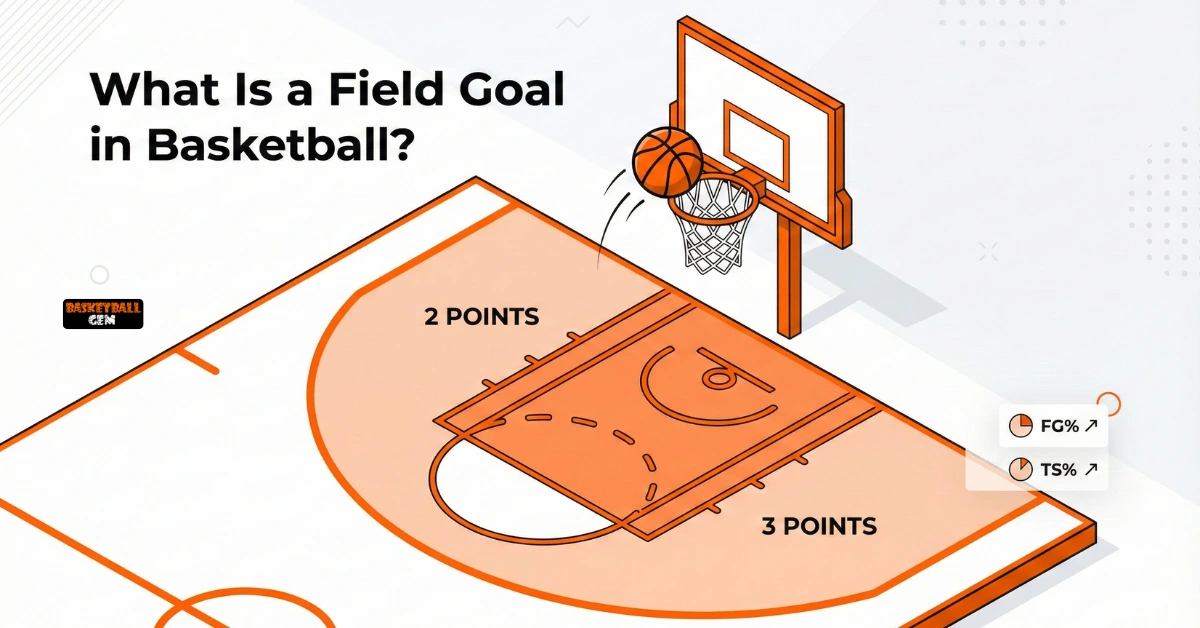
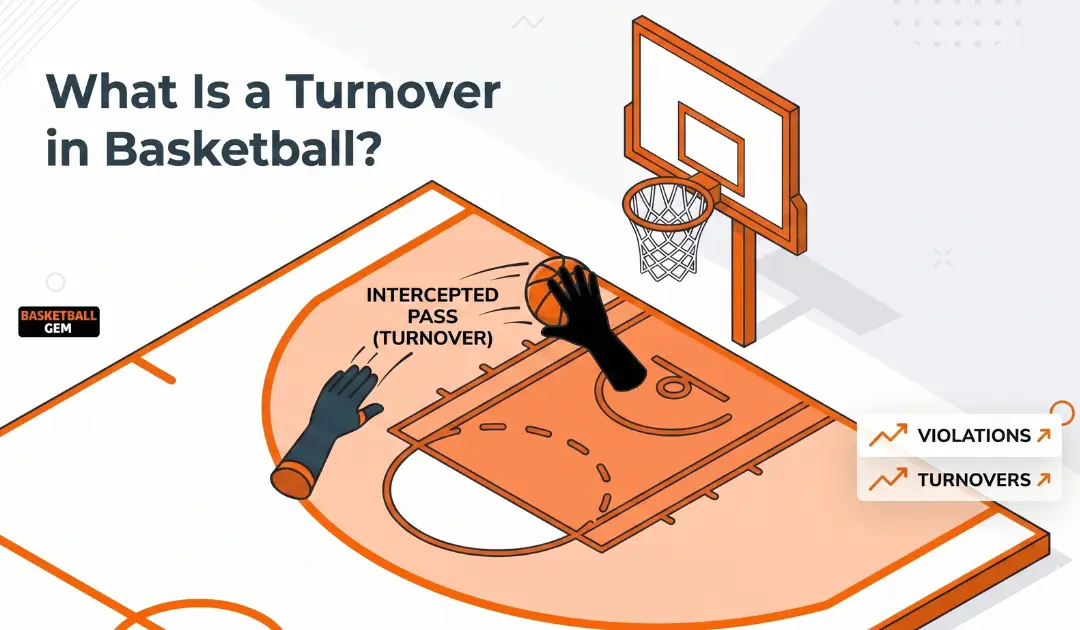
If you are looking to understand more of the fundamental statistics that shape basketball, check out our guides on what a turnover is in basketball and what a field goal is in basketball. Understanding these three stats together will give you a solid foundation for reading any box score at any level of the game.
Frequently Asked Questions
How do you get an assist in basketball?
You get an assist in basketball by making a pass that directly leads to a teammate scoring a field goal. The pass must be the primary reason the basket occurred. The official scorer at the game makes the final determination, using judgment to decide whether the pass meaningfully contributed to the made basket.
What’s a assist in basketball in simple terms?
A simple way to understand it: when you throw the ball to a teammate and they score because of your pass, you get an assist. It is basketball’s way of giving credit to the person who set up the shot, not just the person who took it.
What constitutes an assist in basketball?
For a pass to constitute an assist in basketball, three things must be true: the pass must be the final pass before the made field goal, the receiving player must score in a way that flows directly from the pass (without extensive additional dribbling or shot creation), and the official scorer must judge that the pass meaningfully contributed to the basket. Free throws do not count in the NBA and NCAA, though FIBA does award assists when a foul occurs and the fouled player makes at least one free throw.
Can you get an assist on a three-pointer?
Yes. There is no rule restricting assists to two-point field goals. A pass that leads to a made three-point shot earns an assist just like any other pass leading to a made basket.
Does a goaltending call cancel an assist?
No. If the defensive goaltending call results in points being awarded, and the pass leading to that possession would otherwise qualify as an assist, the passer is still credited with the assist. The scored basket stands for statistical purposes.
What is a “dime” in basketball?
A “dime” is slang for an assist. The term has its roots in American street basketball culture and is used broadly to describe any particularly sharp, accurate pass that sets up a score. Saying a player “dropped a dime” means they made a beautiful assist-worthy pass.
Can an inbound pass count as an assist?
Yes, in both the NBA and NCAA. If the player receiving an inbound pass scores immediately from that action and the inbound pass was the decisive play, the inbounder may be credited with an assist. The scorer uses judgment to decide whether the inbound pass was truly the key action or simply a routine restart.
What is a screen assist?
A screen assist is a separate tracking metric used in NBA advanced data. It counts the number of times a player set a screen that directly led to a teammate making a field goal. Screen assists do not appear in standard box scores but are used by coaching staffs to evaluate the impact of players who set effective picks. You can see this data on the NBA’s official stats page.
Who has the most assists in a single NBA game?
Scott Skiles of the Orlando Magic recorded 30 assists on December 30, 1990, setting the NBA single-game record that still stands today.
Is a high assist total enough to judge a player?
Not on its own. Assists are most meaningful when combined with other statistics. A point guard with high assists but a poor AST/TO ratio may be creating turnovers almost as often as scoring opportunities. A scorer-assist combination, like what LeBron James and Luka Dončić produce, gives teams the most complete offensive threat. Always read assists alongside field goal efficiency, turnover rate, and team offensive rating for a complete picture.