What Is A Triple Threat In Basketball? (Comprehensive Guide)
Last Updated On: May 20, 2026
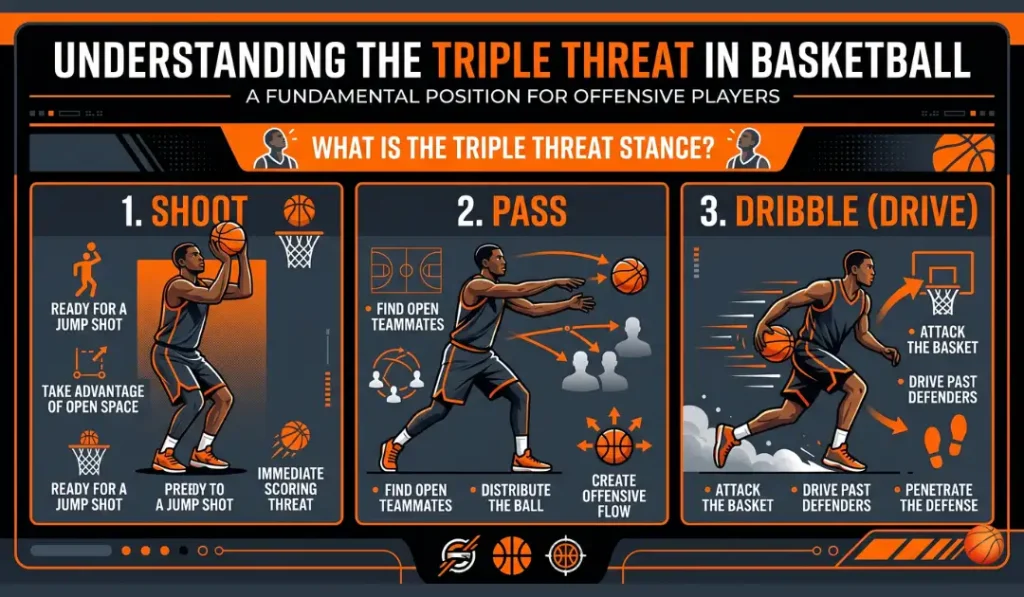
A triple threat in basketball is a stance where the offensive player can shoot, pass, or dribble at any moment while holding the ball. This position keeps the defender guessing and makes the ball handler a constant threat to the defense.
Every great offensive player knows that the moment they catch the ball is one of the most important moments in a possession. In that split second, how you hold yourself and position your body determines everything that follows. That fundamental moment is governed by the triple threat position, and mastering it is one of the biggest skill jumps any player can make at any level.
This guide covers everything you need to know: what the triple threat is, how to get into it correctly, how to use it at every skill level, how to defend against it, and the drills that will turn it from a concept into a natural habit.
What is a triple threat in basketball?
The triple threat is an offensive stance a player takes immediately after catching the ball, before they have dribbled. In this position, the player is balanced and loaded to do any one of three things: shoot, pass, or dribble. Because the defender cannot know which of the three the offensive player will choose, all three are genuine threats simultaneously, hence the name.
According to USA Basketball, the governing body for the sport in the United States, the triple threat position has been a foundational offensive concept taught at every level of the game for decades. It is not a flashy move or an advanced technique; it is the starting point for almost every meaningful offensive action.
When a player is NOT in triple threat position, for example, if they catch the ball standing straight up with their feet together and the ball held loosely at their waist, they telegraph their intentions immediately. The defender can relax and wait to react. The triple threat removes that luxury.
The 5 Key Elements of a Correct Triple Threat Position
Getting into the triple threat position correctly requires attention to five specific physical components. Missing even one of them reduces how dangerous you are.
1. Ball in the Shot Pocket
The ball belongs at your hip, on your dominant hand side, pulled close to your body and away from the defender. This specific location is called the shot pocket. From the shot pocket, you can immediately rise into your shooting motion, drop the ball to the floor to dribble, or swing it into a pass. If the ball is held out in front of you, above your head, or pressed against your chest, none of those transitions happen quickly. The shot pocket is the universal launch point for all three options.
For right-handed players, the ball sits at the right hip. For left-handed players, at the left hip. The ball should feel secure but live — you are protecting it with your body while staying ready to use it.
2. Both Hands on the Ball with Proper Placement
Triple threat requires both hands on the basketball at all times. More specifically, your dominant hand sits behind and slightly under the ball (in shooting position), while your non-dominant hand rests on the side for balance and ball security. This hand placement means you can shoot without repositioning your hands, dribble in either direction without telegraphing where you are going, or make a crisp pass immediately. Any other hand arrangement slows you down and signals your next move to the defender.
3. Eyes on the Rim
Your eyes must go to the rim from the moment you catch the ball. This is what makes the shooting threat credible. A defender watching your eyes can tell whether you are genuinely considering a shot. If your eyes drift down to the floor or sideways to a teammate too quickly, the defender knows you are not shooting and can cheat toward your dribble or passing lanes.
You can and should glance at teammates to survey passing opportunities, but your default gaze returns to the rim. This one habit forces defenders to play you honestly and opens up everything else.
4. Proper Foot Position and Pivot Foot
Your feet should be roughly shoulder-width apart, with one foot slightly ahead of the other. This staggered stance gives you better balance in all directions and prepares you to move explosively. The moment you catch the ball, one foot becomes your pivot foot. You can lift and move your non-pivot foot freely, but the pivot foot must stay planted until you begin your dribble, otherwise, you commit a traveling violation.
Understanding your pivot foot is critical because it is what makes pivoting legally useful. By keeping the pivot foot planted and swinging the other foot, you can open up entirely new passing angles, step into a better shooting position, or create a driving lane that did not exist before. If you accidentally move the pivot foot before dribbling, a travel is called and possession changes hands. To understand how traveling rules work in the NBA specifically, the official NBA rulebook is a reliable reference.
5. Athletic Stance: Knees Bent, Back Straight, Weight Forward
This is the stance that ties everything together. Your knees should be bent enough that you can push off explosively in any direction. Your back stays straight, not hunched over the ball, not leaning back. Your weight sits on the balls of your feet rather than your heels, keeping you mobile and reactive. Shoulders are squared toward the basket whenever possible, because squaring up gives you a direct line to the hoop for either a shot or a drive.
An athletic stance is not unique to triple threat, it is the base position for almost all basketball movements. Think of it the same way a shortstop is ready between pitches: loaded, balanced, and set to go in any direction.
Why the Shoot-First Mentality Is the Key to Making Triple Threat Work
Many players learn the three options of triple threat but still fail to use it effectively. The reason is usually this: they do not actually threaten to shoot.
The shooting threat is what makes the other two options possible. When a defender genuinely believes you might pull up and shoot, they must close out on you hard and play you high. That close-out creates space to drive around them. It also forces them to commit, and once they commit, a pass to the open teammate becomes easy.
But when you catch the ball with no intention of shooting and your eyes never look at the rim, the defender sees through it. They can sag back, protect the paint, and take away your driving lane because they know you are not going to shoot from where you are.
The shoot-first mentality does not mean taking bad shots. It means genuinely evaluating the shot option first on every catch. Are you open? Is the defender giving you space? Is this a shot you can make from this spot? If yes, shoot. If the defender closes out to stop the shot, that is your cue to drive or pass. The shot does not have to go up every time — it just has to be a real possibility every time.
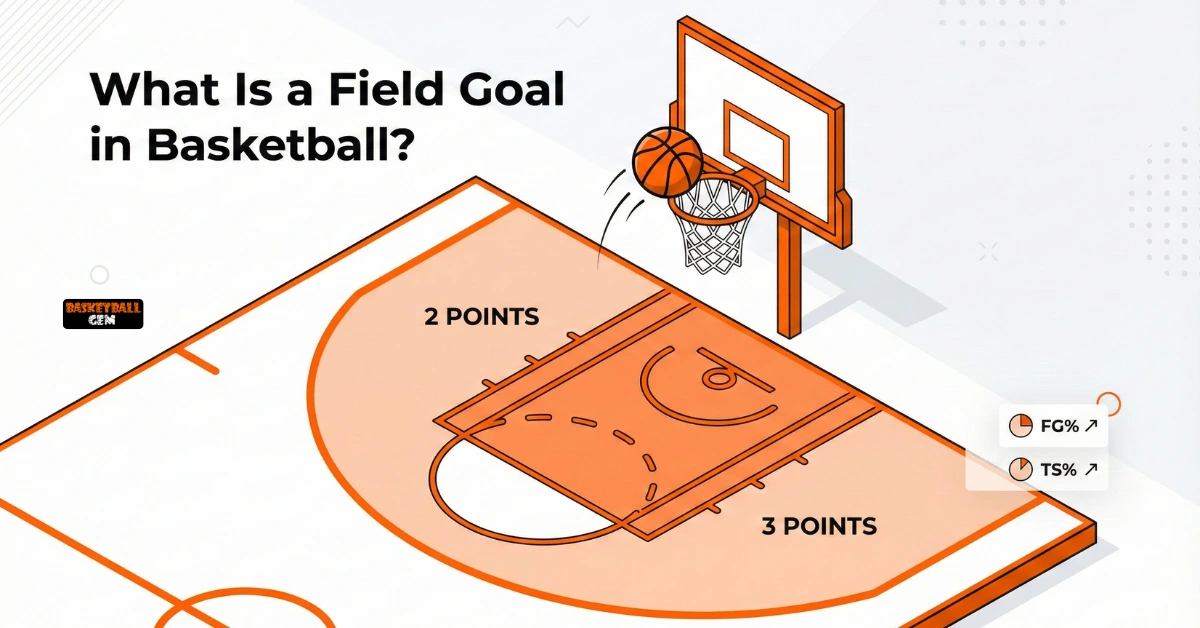
This concept is why perimeter shooting matters so much in the modern game. A player who cannot shoot from the outside can be left open, and their triple threat has one dimension removed. Developing your outside shot is one of the best investments you can make in your overall offensive game. If you want to understand how shooting connects to scoring, our breakdown of what a field goal is in basketball covers the scoring mechanics clearly.
The Three Options Out of Triple Threat Position
Option 1: Shoot the Ball
To shoot from triple threat, you square your shoulders to the basket, rise up through your legs, and release the ball from your shot pocket directly into your shooting motion. Because the ball is already in the shot pocket and your hands are already in shooting position, the transition is fast. Selling the shot convincingly, through your eyes, your shoulder movement, and a subtle rise, is what creates the opportunity.
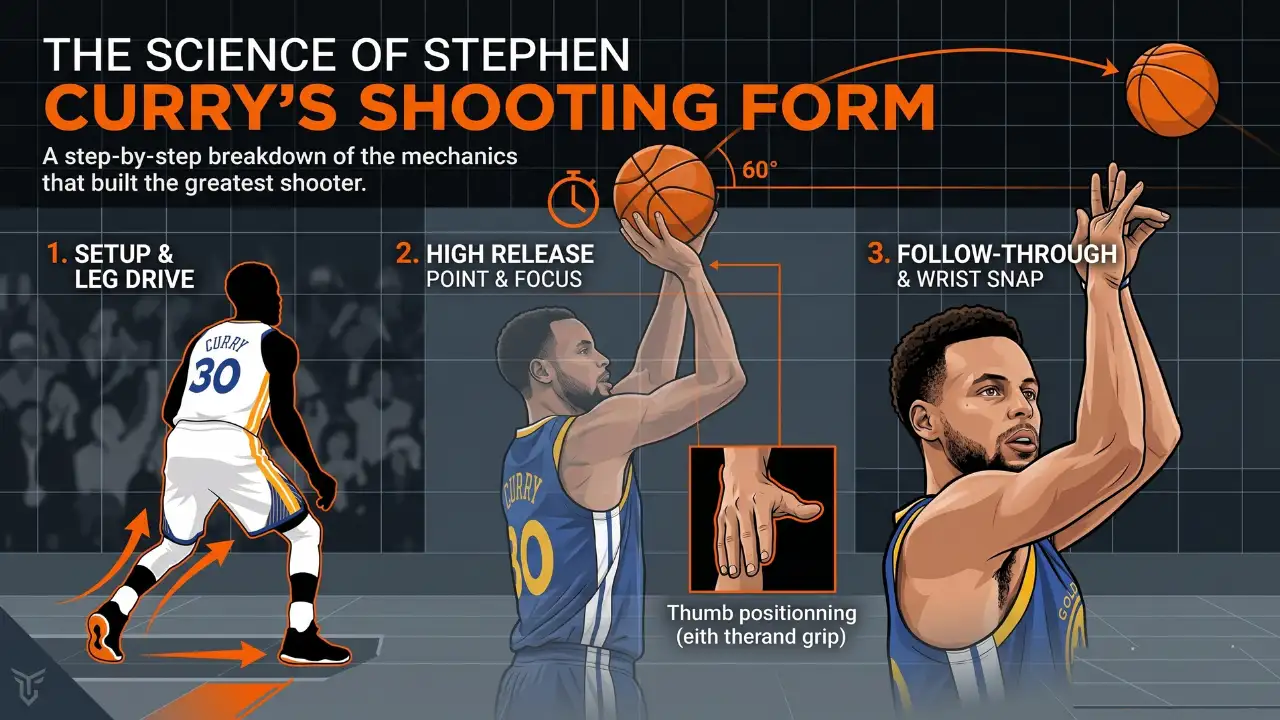
Even if you do not shoot, a well-sold shot fake can freeze the defender long enough to create an opening. To see how shooting mechanics combine with footwork at an elite level, our in-depth look at Stephen Curry’s shooting form breaks down what world-class technique looks like from stance to release.
Option 2: Pass the Ball
Passing from triple threat is most powerful after you have used your pivot foot to open new lanes. By swinging your non-pivot foot, you can step around a defender who is playing in front of you, exposing a teammate who was previously shielded. Delivering a sharp pass after a pivot is far easier than trying to throw a pass from a flat-footed position.
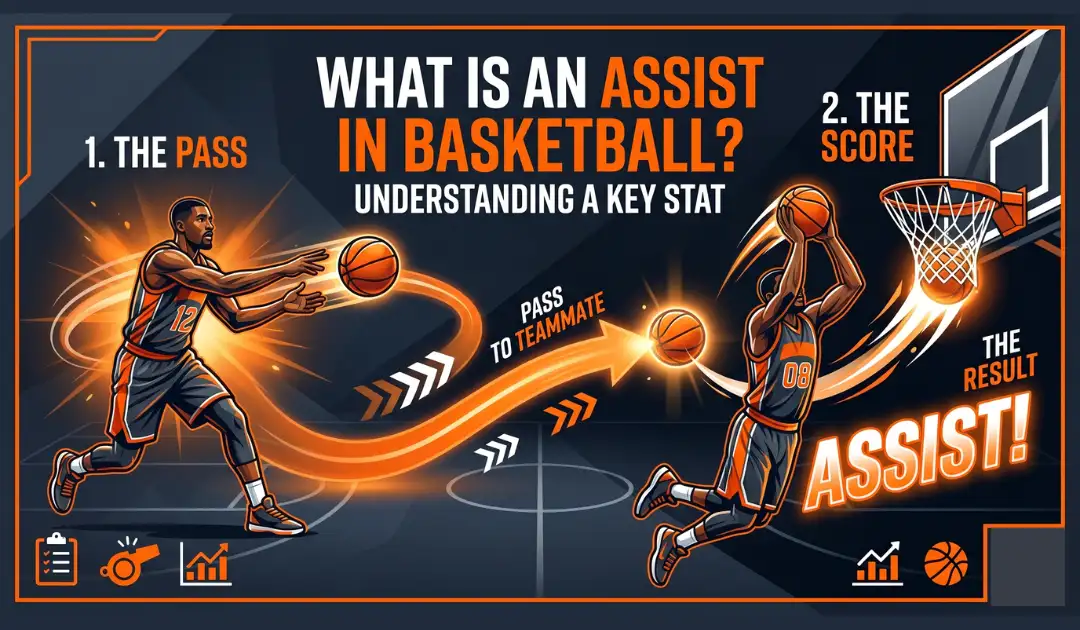
The moment you pass, you give up the ball and your team’s possession continues, so make sure you are passing to an open teammate who is in a position to do something productive. Understanding what a good pass leads to is useful context: our article on what an assist in basketball is explains how passes translate into scoring.
Option 3: Dribble the Ball
If neither the shot nor the pass is available, the dribble creates movement and new possibilities. When you decide to dribble, push the ball out ahead of you in the direction you are driving and attack in a straight line toward the opening. Do not expose the ball by swinging it wide before pushing it forward, that gives the defender time to deflect it.
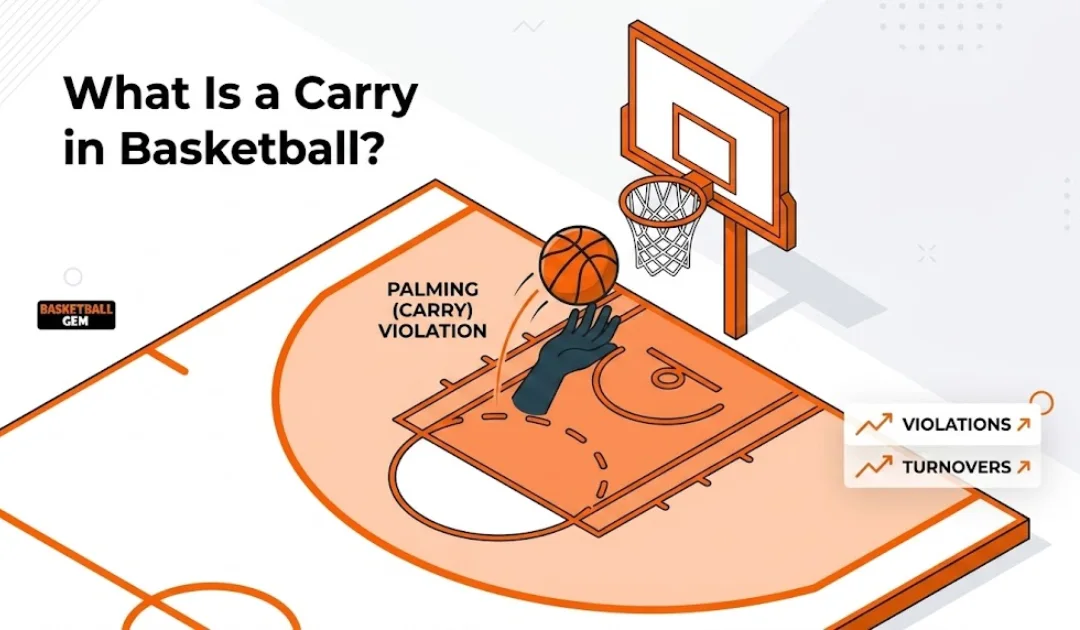
Once you have put the ball on the floor, your triple threat ends and the traveling rules shift. If you pick up your dribble without shooting or passing, you commit a dead-ball situation. Be aware that certain dribbling habits, like carrying or palming the ball, create violations. Our article on what a carry is in basketball covers those rules in detail.
Pivot Foot Mechanics and Traveling Rules
One of the most common mistakes players make in triple threat is confusing their pivot foot or forgetting to establish one. Here is how it works in plain terms.
When you catch the ball with both feet on the ground, you choose which foot is your pivot foot, typically the foot you land on last, or whichever foot feels most natural for your dominant side. Once you make that choice (and in game situations, it often happens instinctively), that foot cannot come off the ground until you begin your dribble.
What you can do with the pivot foot: you can spin on it, rotate around it, and shift your weight on it. What you cannot do: lift it off the ground and put it back down before dribbling, or drag it across the floor.
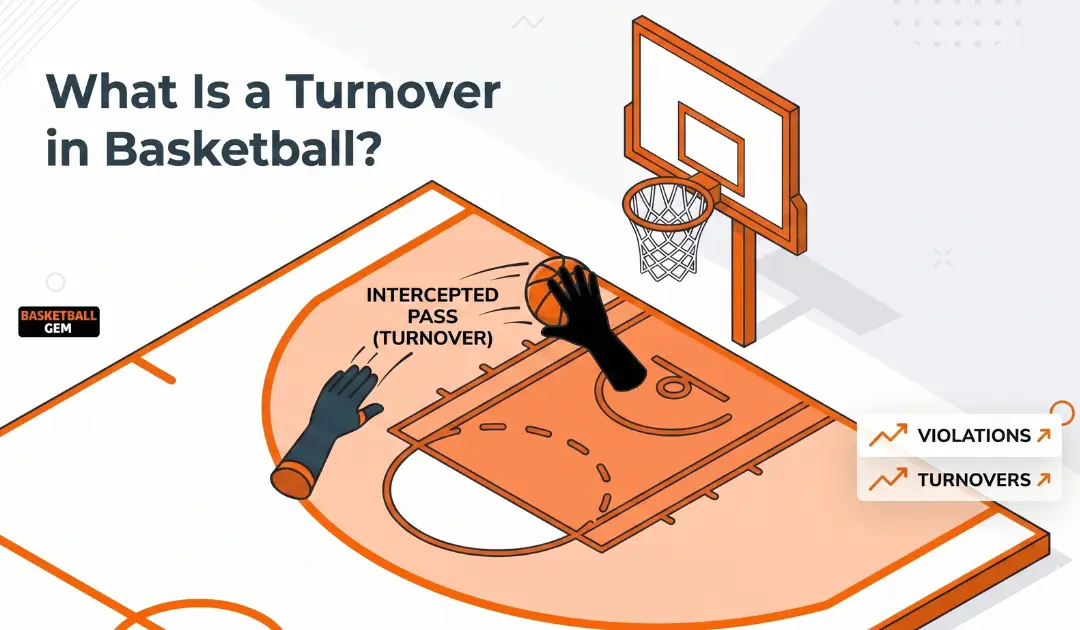
The common traveling violation in triple threat happens when a player pumps fakes, gets the defender airborne, and then shuffles their feet before gathering the dribble. The fake is legal; shuffling the pivot foot before dribbling is not. Knowing this rule prevents you from giving away easy possessions. Understanding the various ways possession can change hands is covered in our guide to turnovers in basketball.
Triple Threat Drills to Build the Habit
Knowing the theory is one thing. Building the muscle memory to get into triple threat automatically on every catch is another. These four drills are specifically designed to develop that habit.
Drill 1: Form Check Hold
Drill 2: Triple Threat to Action
Drill 3: 1-on-1 Off the Catch
Drill 4: Decision-Time Scenarios
Common Triple Threat Mistakes and How to Fix Them
Even players who understand the concept make the same recurring errors. These are the three most common ones.
Mistake 1: Holding the ball too far from the body.
When the ball drifts out in front of you, arms extended, it is easy for a defender to reach in and strip it or deflect a pass. It also slows your transition into the shooting motion.
Fix: pull the ball back to the shot pocket and use your body and the non-shooting forearm as a shield.
Mistake 2: Feet too close together or flat-footed.
A narrow stance means you cannot push off in either direction without first adjusting your feet, and that adjustment is the time the defender needs to recover. Flat feet mean you are locked in place and unable to react quickly.
Fix: spread your feet to shoulder width, bend your knees, and put your weight on the balls of your feet before the ball arrives.
Mistake 3: Immediately dribbling on every catch.
This is the most damaging mistake, especially for developing players. Picking up the dribble the moment you catch the ball eliminates two of your three options instantly. You can no longer shoot off the catch cleanly, and your pivot-foot-based passing lane options disappear. The defense knows exactly what is coming.
Fix: practice pausing for one second on every catch in triple threat before making any decision. That one second is often enough to read the defense correctly.
How to Defend Against the Triple Threat Position
Understanding how to defend the triple threat makes you a more complete player and gives you empathy for what offensive players are trying to do when you face them.
Triple Threat at Different Skill Levels
The triple threat looks and functions differently depending on where a player is in their development. Here is how to think about it at each stage.
Beginner Players
At the beginner level, the goal is simply to develop the habit of stopping, catching, and getting into position before making any move. The recommended sequence is: catch, pause, look. Most beginners will naturally want to pass first, it feels safe and involves a teammate. Lean into that instinct. Practice the pass option, then layer in the dribble, and introduce shooting last when footwork and confidence have grown.
Intermediate Players
At this stage, players understand the position and can execute all three options. The focus shifts to reading the defender faster and making decisions with more pressure. The recommended sequence shifts to: dribble, then shoot, then pass. The dribble creates movement that opens up the other two options, and intermediate players tend to be more comfortable initiating off the bounce than off the catch.
Advanced Players
Advanced players think about the triple threat before they even receive the ball. They set up their cuts and positioning to receive the ball already squared to the basket, making the stance immediate rather than something they have to work to achieve. For these players, the sequence is: shoot, then dribble, then pass. Their shooting threat is real enough that it governs everything else, and they can read and react to the defense’s response in under a second.
Is Triple Threat Still Relevant in the Modern NBA?
This is a fair question. The NBA game has shifted substantially toward speed and flow: the pick-and-roll, off-ball movement, and actions designed to catch defenders transitioning. Players like Nikola Jokic rarely reset into a textbook triple threat stance. So does it still matter?
The answer is yes, and the reason is that triple threat is not specific to a system, it is a decision-making framework. Every time a player catches a ball on the perimeter and has not yet dribbled, they are in the same decision point the triple threat was designed to govern: shoot, pass, or go. What has changed is the speed at which top players make that decision, not the decision itself.
In youth and amateur basketball, the triple threat stance is as important as it has ever been. Players who have not developed the instinct to stop and read the defense first consistently make impulsive choices: dribbling into traffic, passing into defenders, or taking off-balance shots. The triple threat teaches deliberate decision-making under pressure, and that skill never stops being valuable.
Where the stance has evolved is at the elite level. Modern NBA players often catch in a one-motion flow, they catch and immediately go into a layup, pull-up, or pass without ever planting both feet and pausing. That fluidity is the result of thousands of hours of triple threat practice making the read automatic. They are not ignoring the concept; they have internalized it to the point that the pause disappears.
Triple Threat by Position
While every player benefits from understanding the triple threat, how they use it varies by position.
Final Thoughts
The triple threat position is not complicated, but it is precise. Every element, ball placement, hand position, eyes, footwork, and stance, works together to create maximum pressure on the defense. When any one of those elements is off, the threat diminishes.
The goal is not to stand in a triple threat and think about it. The goal is to practice it so many times that your body goes there automatically on every catch, and the decision of what to do next happens instinctively in response to what the defense gives you.
That is the difference between knowing what a triple threat is and actually being one.
Frequently Asked Questions
Why is it called a triple threat?
It is called a triple threat because the offensive player holding the ball represents three simultaneous threats to the defense: they can shoot, pass, or dribble. None of those options can be eliminated until the player chooses one, so the defense must account for all three at once.
What is the difference between the triple threat position and an athletic stance?
An athletic stance is the general ready position used throughout basketball for both offense and defense — knees bent, feet shoulder-width apart, weight forward. The triple threat position is an offensive-specific version of that stance taken when you have the ball before dribbling, with the addition of the ball at the shot pocket in shooting-ready hand placement and eyes directed at the rim.
Can you use triple threat in the post?
Yes. Post players who receive the ball with their back to the basket and pivot to face the defender are effectively getting into a face-up version of the triple threat. The same three options — shoot the face-up jumper, drive, or pass — apply. It is sometimes called “facing up” from the post, but the concept is the same.
What foot is the pivot foot in triple threat?
It depends on how you catch the ball. If you catch with both feet on the ground, you choose your pivot foot — typically the foot on your dominant side for most players. If you catch in motion and land on one foot first, that foot automatically becomes the pivot foot. The key rule is that once you establish the pivot foot, it cannot leave the ground until you begin your dribble.
How do you practice triple threat alone without a defender?
You can work on your stance and footwork alone by catching passes from a rebounder machine or off the wall, immediately locking into position, and then executing a move. Mirror work is also valuable: stand in front of a mirror and check your own form — ball at the hip, knees bent, eyes forward. Add jab steps, shot fakes, and pivots to build fluidity. The form check drill described earlier in this guide works well with just a wall pass or a ball return machine.
Is triple threat still used in modern NBA basketball?
Yes, though it is less visually obvious at the elite level because the decision-making has become so fast. Every NBA player still faces the same catch-and-decide moment that triple threat governs — shoot, drive, or pass. The stance has become more of a mental framework than a visible pause, but the underlying skill is the same one that youth coaches teach on Day 1.
What is a jab step in the triple threat position?
A jab step is a short, sharp step with the non-pivot foot toward the defender, intended to force a reaction. If the defender backs up in response, you have created shooting space and can rise for the shot. If they do not move, you can cross over and drive past them. The jab step is one of the most useful fakes available from the triple threat position and is worth practicing separately as its own skill.