
How to Become an NBA Referee: Step-by-Step Guide (2026)
Last Updated On: Sep 26, 2026
Becoming an NBA referee is one of the most competitive career paths in professional sports. There are only around 74 active officials working in the NBA at any given time, and earning one of those spots takes years of dedication, thousands of hours of game experience, and successfully navigating the league’s highly selective evaluation system.
But here is the good news: the path is clearly defined. The NBA has an established pipeline that starts at the local level and moves through high school, college, and the G League before reaching the NBA. If you are willing to put in the work, this guide walks you through every single step.
Quick Answer: To become an NBA referee, you start by officiating youth and recreational basketball, then earn state certification to work high school games, build experience through college conferences, and eventually get invited to the NBA’s three-stage evaluation camp system. From there, the top performers are placed in the NBA G League, where the best officials are promoted to the NBA after several years of proven performance.
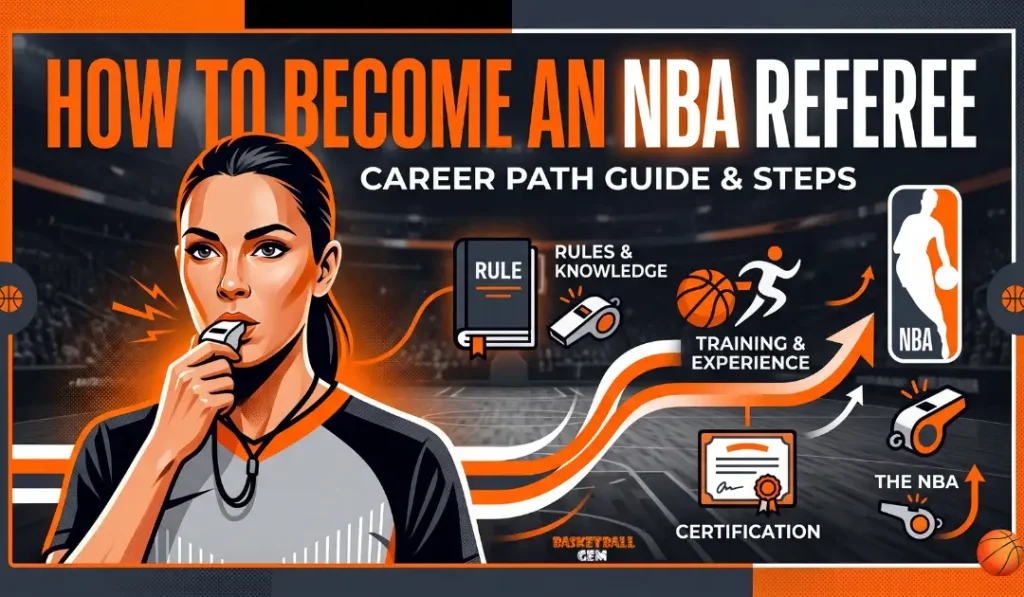
What Does an NBA Referee Do?
Before diving into the career path, it helps to understand exactly what the job involves day to day.
NBA referees are responsible for enforcing the rules of basketball during every possession of every game. They call fouls, manage violations like traveling and carrying, oversee jump balls, issue technical fouls, and hand down ejections when necessary. They also coordinate instant replay reviews with the NBA’s officiating headquarters in New York, announce challenge decisions via the in-arena microphone, and track team foul counts to enforce bonus free throw situations.
Beyond the court itself, the job demands a serious lifestyle commitment. NBA referees travel by car or airplane to officiate games across the country, often working late nights and weekends across multiple time zones. They show up well before tip-off to prepare for each game and must stay in peak physical condition throughout a season that runs from October through June, including the playoffs.
Understanding how long an NBA game actually lasts gives you a sense of the physical endurance required. While the clock shows 48 minutes, real-world game time regularly stretches to two and a half or three hours, with referees running and backpedaling up and down the court for most of that time.
NBA Referee Requirements
Before worrying about camp invitations and league evaluations, you need to meet the baseline requirements that apply at every level of the path.
How to Become an NBA Referee: 7 Steps
Step 1: Start at the Local and Youth Level
Every NBA official began somewhere small. The vast majority started by officiating recreational leagues, YMCA games, or local youth basketball programs.
This is where you learn the fundamentals of officiating mechanics: how to position yourself on the court, how to communicate calls using proper hand signals, and how to manage the pace and temperament of a game. You do not need any prior officiating experience to start here. Simply contact your local parks and recreation department or community sports organization to find out about open referee positions.
Youth officiating also teaches something that no rulebook can fully prepare you for: how to maintain calm authority in a room full of competitive, emotional people. That skill becomes more valuable the higher you climb.
Step 2: Get State Certified to Work High School Games
After building experience at the youth level, the next step is earning certification to officiate high school basketball. This is where officiating careers truly begin to take shape.
Each state has its own governing body for high school athletics. In California, for example, the California Interscholastic Federation (CIF) oversees high school sports officiating, and anyone looking to learn how to become a basketball referee in California must register with the CIF, complete a rules examination, pass a background check, and demonstrate their officiating mechanics through an assessed practical evaluation. Similar systems exist in every state, governed by organizations like the Texas University Interscholastic League (UIL), the Illinois High School Association (IHSA), and others.
The National Association of Sports Officials (NASO) is the best national resource for finding your state’s specific certification requirements. Beyond the paperwork, NASO also recommends attending local officiating clinics and camps to sharpen your skills and get in front of evaluators early in your career.
High school officiating is where reputations are built. How you handle pressure situations, communicate with coaches, and recover from missed calls all gets noticed by assignors and veteran officials who have connections to higher-level leagues.
Step 3: Build Experience at the Collegiate Level
Moving from high school to college officiating is a significant leap, and the National Association of Sports Officials recommends having at least one full season of high school experience, and often considerably more, before making this move.
College officiating is governed by the NCAA at the university level and by the NAIA for smaller programs. Officials typically begin by working games in smaller Division III or NAIA conferences before earning opportunities in Division II and eventually the lower rungs of Division I.
Your application to officiate collegiate games generally requires a resume, video clips of your officiating, written knowledge assessments, and an in-person interview or assessment session. These evaluations are competitive from the start.
Understanding the game deeply matters enormously at this stage. The more you know about rules nuances, such as the difference between a field goal attempt and a non-scoring play when it comes to resetting shot clocks, the better equipped you will be to handle fast-moving situations at the college level.
Step 4: Network and Attend Regional Officiating Camps
Getting to the NBA is not purely about performance on the court. It is also about being seen by the right people.
Throughout your high school and college officiating career, actively seek out regional officiating camps and clinics. These events serve two critical purposes. First, they accelerate your development by exposing you to high-level coaching and peer feedback you would never get working games alone. Second, they put you in front of officiating supervisors and evaluators who have direct connections to the NBA scouting network.
Building strong relationships with experienced officials, conference supervisors, and assignors is one of the most consistent pieces of advice that current NBA referees share when discussing their career paths. The officiating world is smaller than it appears from the outside, and your reputation within it travels faster than you might expect.
Step 5: Get Invited to an NBA Grass Roots Camp
This is where the NBA’s formal evaluation process begins. According to NBA Officials, the league maintains a scouting network of former referees who travel the country watching high-level college games and identifying the most talented officials in the country.
Each year, thousands of candidates are considered, but only around 100 officials receive an invitation to the NBA Grass Roots Camp. The criteria used to narrow the list are demanding: you need significant officiating experience at a high level, strong evaluations from supervisors, and the right combination of physical presence, decision-making ability, and court management skills.
You can also increase your chances by registering for national open tryouts when they are available, which the NBA occasionally hosts to supplement its scouting pipeline. Staying active in your officiating associations and maintaining strong relationships with people who can advocate for your candidacy is equally important.
Step 6: Progress Through the Mid-Level and Elite Camps
The NBA runs three sequential evaluation camps each spring and summer after the regular season ends.
Officials who perform best at the Grass Roots Camp earn an invitation to the Mid-Level Camp. From there, top performers move on to the Elite Camp. The field shrinks at each stage, and the evaluation is comprehensive. Assessors grade candidates on their knowledge of the rulebook, the speed and accuracy of their decision-making, their physical conditioning, their ability to manage game situations under pressure, and their overall potential to perform at the highest level.
This is not a single-year audition. Many officials attend Grass Roots camps multiple times before advancing. The NBA’s scouting team is patient and thorough, because the stakes of adding the wrong person to its officiating ranks are very high.
Step 7: Work the NBA G League and Earn Your Promotion
Officials who finish among the top performers at the Elite Camp are offered contracts to join the NBA G League officiating staff for the upcoming season.
The NBA G League is the NBA’s official player development minor league, and it serves the exact same function for referees. G League officials work a full season of games, subject to constant observation from NBA officiating supervisors. Their rules knowledge is tested regularly, and their game performances are reviewed and graded in detail.
After accumulating enough G League seasons and demonstrating the consistency and composure expected at the NBA level, referees can formally request consideration for a promotion to the NBA. That recommendation typically comes through their direct supervisor, and it is based entirely on sustained high performance over time.
The NBA Officiating Camp System Explained
Many people assume that getting into the NBA involves sending in a resume or applying online. The reality is more specific than that.
The three-stage camp system is the primary route into professional officiating. The Grass Roots Camp is the entry point, accessible by invitation only based on the NBA’s scouting evaluations. It functions as a broad talent identification exercise where around 100 of the country’s top officials are put through structured evaluations.
The Mid-Level Camp is a smaller group of the highest finishers from Grass Roots. At this stage, candidates are already being seriously evaluated as potential G League or even NBA officials.
The Elite Camp is the final evaluation before G League placement offers are made. It includes the strongest candidates from the Mid-Level stage and produces a very small group of new G League hires each year.
The entire pipeline is competitive at every rung, and patience is as important a quality as skill. Most NBA officials spent a decade or more working through this system before reaching the league.
How Long Does It Take to Become an NBA Referee?
This is one of the most common questions people ask, and the honest answer is: a very long time.
Most working NBA officials spent between 10 and 20 years officiating before they ever set foot on an NBA court in an official capacity. That timeline typically breaks down roughly as follows: two to four years building youth and high school experience, three to five years working collegiate games across progressively higher conference levels, and then multiple years in the G League after successfully navigating the NBA camp system.
The most important thing to understand is that there are no shortcuts. Even officials who are exceptionally talented still need to accumulate the game experience and evaluator relationships that the process demands. Trying to rush through any stage typically backfires, because supervisors at each level are evaluating not just your mechanics but your maturity and ability to perform under sustained pressure.
NBA Referee Salary: How Much Do They Earn in 2026?
The financial rewards at the top of this career are significant. According to data reported by Front Office Sports and other sports business publications, entry-level NBA referees can expect to earn between $150,000 and $250,000 per year. As officials gain experience and take on higher-profile assignments, including playoff games, conference finals, and the NBA Finals, their compensation increases considerably.
Veteran NBA referees with 20 or more years of experience can earn upward of $500,000 annually. Scott Foster, one of the league’s longest-tenured officials with over 30 years of service, has reportedly earned more than $550,000 per year in recent seasons.
NBA referees are also represented by the National Basketball Referees Association (NBRA), their union, which collectively bargains with the league on salary scales, benefits, and working conditions. This provides job security and protections that are relatively rare in sports career paths.
G League officials earn considerably less while building their resumes, but the G League experience is the necessary investment that makes the NBA salary possible.
Skills Every NBA Referee Needs
Technical knowledge of the rules is only one piece of what makes an effective NBA official. The following skills are equally important and are specifically evaluated throughout the camp and G League pipeline.
NBA Referee Responsibilities: A Full Game-Day Breakdown
Understanding exactly what NBA referees are responsible for during a game gives aspiring officials a clearer picture of what they are training toward.
During a game, NBA referees are responsible for calling fouls, violations, and out-of-bounds plays in real time. They classify each foul accurately, whether it is a common foul, a flagrant one, a flagrant two, a technical foul, or a call that warrants an ejection. They track team foul totals throughout each quarter and enforce the bonus free throw situations that result when those totals are reached.
Officials also manage all replay reviews. When a team challenges a call or when a review is automatically triggered late in a close game, the referee communicates with the NBA’s replay center in Secaucus, New Jersey, receives the ruling, and then announces the final decision to both teams and the arena.
After every game, NBA officials submit written reports and their performances are formally graded by the league’s officiating department. Those grades accumulate over a career and directly affect playoff assignments, compensation, and career longevity.
Job Outlook for NBA Referees
The career outlook for sports officials broadly is positive. According to the Bureau of Labor Statistics, employment for umpires, referees, and other sports officials is projected to grow 32% between 2021 and 2031, which is substantially faster than the national average for all occupations.
However, the NBA specifically is an extremely tight market. With only 74 active officials employed by the league and very limited roster turnover each year, only a handful of new officials are added in most seasons. This makes reaching the NBA level genuinely rare, even for talented and hardworking candidates.
One factor worth watching is the NBA’s growing interest in officiating technology, including automated systems for detecting certain violations. While this is unlikely to eliminate referees entirely, it may gradually reduce the number of officials needed on the court for some call types, making the competition for available positions even stiffer in the years ahead.
Women and Diversity in NBA Officiating
For a long time, NBA officiating was exclusively male. That began to change in 1997 when Violet Palmer and Dee Kantner became the first women to officiate NBA regular-season games. Lauren Holtkamp-Sterling has been one of the most prominent female NBA officials in recent seasons, serving as a full-time staff referee and demonstrating that the evaluation pipeline is genuinely open to candidates regardless of gender.
The NBA has also made deliberate efforts to recruit and develop diverse officiating candidates through its grassroots scouting and camp invitation processes. The same pipeline and standards apply to all candidates, and excellence in officiating is ultimately what determines who advances through it.
Final Thoughts
Becoming an NBA referee is a long game in every sense of the phrase. There are no shortcuts, no back-channel applications, and no alternative routes around the officiating pipeline that the league has built. But for those who are passionate about basketball and willing to invest the years of work that the process demands, it is an achievable goal.
Start by officiating your first youth game. Earn your state certification. Work high school and college games, seek out camps and evaluators, and build the reputation that eventually gets you noticed by the NBA’s scouting network. Every NBA referee working today took exactly this path, and most of them will tell you the journey was worth every year of it.
If you want to deepen your understanding of the game while you build your officiating career, explore our guides on basketball rules and fundamentals, what constitutes a turnover, and how the NBA game clock works. The better you understand the game from every angle, the stronger your officiating will be.
Frequently Asked Questions
How do you become a basketball referee at any level?
The process of how to become a basketball referee starts with officiating youth or recreational leagues to build your foundational skills. From there, you earn state certification to work high school games, gain experience at progressively higher levels of competition, and pursue opportunities in collegiate and eventually professional leagues. The National Association of Sports Officials at naso.org is the best starting point for finding your state’s certification requirements and local officiating programs.
How do I become a basketball referee in California?
To become a basketball referee in California, you register with the California Interscholastic Federation (CIF), which governs high school athletics in the state. The CIF requires you to complete an officiating course, pass a written rules examination, undergo a background check, and demonstrate your mechanics through an assessed evaluation. Once certified, you can work games through your local CIF section assigning office. The process to learn how to become a basketball referee in California is well documented on the CIF’s official website at cifstate.org.
How many NBA referees are there?
There are approximately 74 active NBA officials working in any given season. Given the total number of regular-season games played each year, this is a very lean officiating staff, and roster spots are highly competitive.
Do NBA referees travel to every game?
Yes. NBA referees travel to road games just like players and coaches do. They fly or drive to different NBA markets throughout the regular season, working late nights and weekends across multiple time zones. The travel demands of the job are significant and are one of the lifestyle considerations that candidates need to be prepared for before pursuing the career seriously.
Do you need a college degree to become an NBA referee?
No. A college degree is not a formal requirement to become an NBA referee. The minimum education requirement is a high school diploma or GED equivalent. However, many successful officials do hold college degrees, and the four years of college can be a useful time to begin building your officiating resume at the intramural or community level while also making connections within the college basketball world.
Can women become NBA referees?
Absolutely. Women have been officiating in the NBA since 1997, when Violet Palmer and Dee Kantner became the first female officials in the league’s history. Lauren Holtkamp-Sterling has served as a full-time NBA referee in recent seasons. The same evaluation pipeline and performance standards apply to all candidates, and gender is not a barrier to reaching the NBA level.
How hard is it to become an NBA referee?
It is extremely competitive. With only 74 active positions in the league and very few openings in any given year, only a small fraction of even highly experienced collegiate officials ever reach the NBA. The process typically takes 10 to 20 years from beginning to officiate to reaching the NBA level, and it requires navigating the NBA’s invitation-only camp system and proving yourself consistently over multiple G League seasons.

