
What Is a Field Goal in Basketball? 2‑Point, 3‑Point Shots and FG% Explained
A field goal in basketball is any basket scored during live play, excluding free throws, and it is worth either two or three points depending on where the shot is taken. This guide explains what counts as a field goal, how many points it’s worth, common shot types, key statistics, and important rules in an easy, beginner‑friendly way.
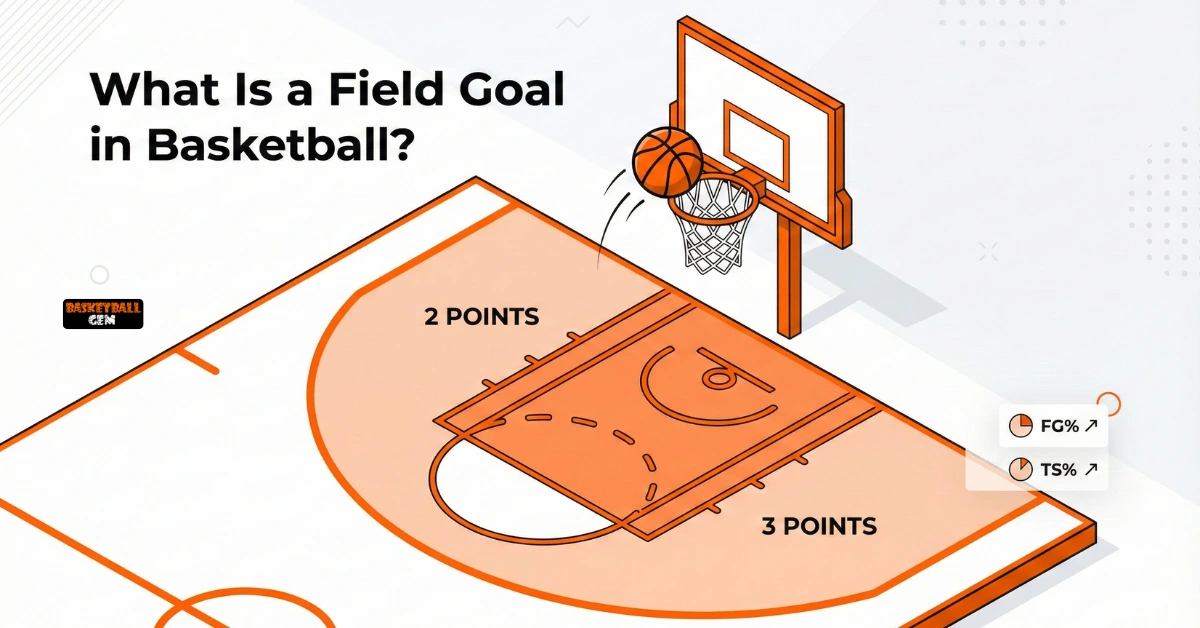
What Is a Field Goal in Basketball?
A field goal is any basket scored on a shot or tap other than a free throw while the ball is in live play. The shot can be taken from anywhere on the court as long as the player is inbounds and releases the ball before the shot clock expires.
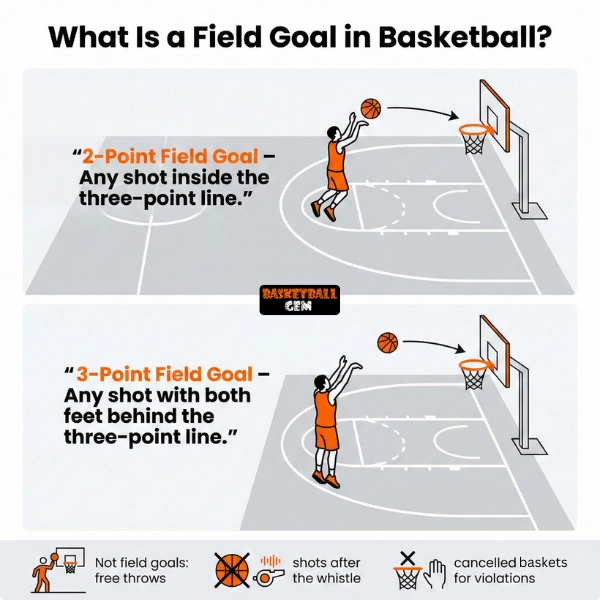
Field goals are the main way teams score in basketball and include everything from layups and dunks to long three‑pointers. Free throws do not count as field goals because they are awarded after certain fouls and are always worth one point.
How Many Points Is a Field Goal Worth?
The number of points depends on where the shooter is standing when they release the ball.
Some basketball formats use different scoring systems.
Types of Field Goals
Field goals can be grouped into close‑range shots near the basket and perimeter shots farther from the hoop.
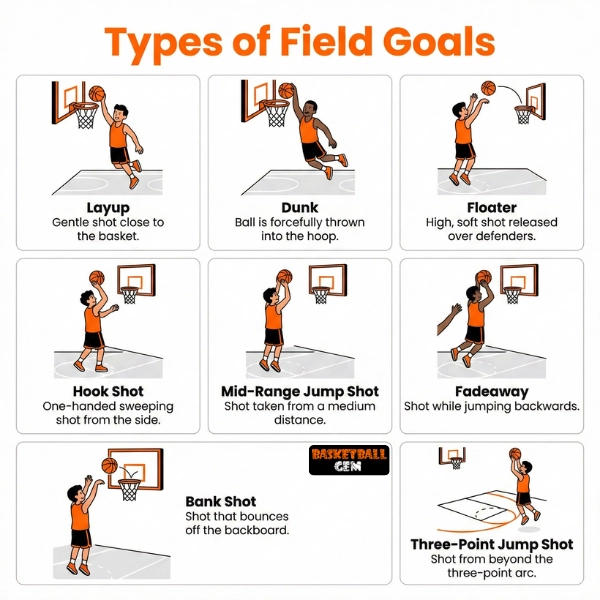
Close‑Range Field Goals (Usually 2 Points)
These shots are taken inside the three‑point line, often near the paint.
Perimeter Field Goals (2 or 3 Points)
Perimeter shots are taken farther from the hoop and include mid‑range and three‑point attempts.
What Does NOT Count as a Field Goal?
Certain plays do not count as field goals even if the ball goes through the basket.
What Happens After a Made Field Goal?
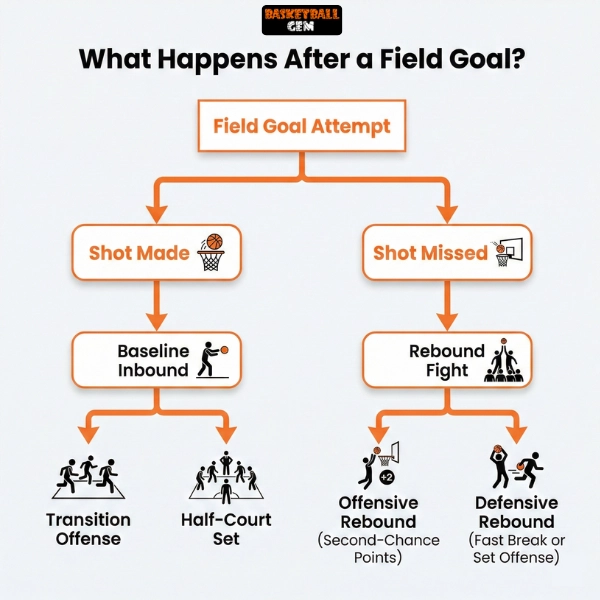
When Team A makes a field goal, Team B immediately has a chance to inbound the ball from the baseline behind the basket.
This quick change from offense to defense and back is one of the main reasons basketball is such a fast game.Understanding how often teams score field goals also depends on game length, timeouts, and pace, which we break down in our guide on how long a basketball game is.
What Happens After a Missed Field Goal?
If a field goal attempt misses, both teams try to secure the rebound.
Rebounding after missed field goals is a major factor in controlling the pace of the game and creating extra scoring opportunities.
Field Goal Violations: Goaltending and Basket Interference
Some rule violations can affect whether a field goal counts or not.
Goaltending
Goaltending occurs when a defender illegally touches a shot that has a chance to score while it is on its way down, above the rim, or after it has hit the backboard above the rim.
Basket Interference
Basket interference generally happens when a player touches the ball or the basket while the ball is on or within the imaginary cylinder above the rim.
Under FIBA rules, once the ball touches the rim and bounces upward, offensive or defensive players may legally tap it, which is slightly different from NBA rules. Not every mistake relates to the shot itself—ball‑handling violations like a carry in basketball can stop a field goal attempt before it even happens.
Field Goal Statistics: FGM, FGA, FG%
Field goal stats show how well and how often a player or team scores from the field.
|
Stat |
Abbreviation |
What it shows |
|---|---|---|
|
Field Goals Made |
FGM |
Number of field goals successfully scored. |
|
Field Goals Attempted |
FGA |
Number of field goal shots taken, whether made or missed. |
|
Field Goal Percentage |
FG% |
Shooting efficiency: how many shots go in out of attempts. |
Field Goals Made (FGM)
Field Goals Made is the total number of successful field goals a player or team scores in a game or over a season. It includes both two‑point and three‑point baskets.
Field Goals Attempted (FGA)
Field Goals Attempted counts every shot a player takes from the field, regardless of whether it goes in. It includes layups, jump shots, dunks, and three‑pointers but does not include free throws.
Field Goal Percentage (FG%)
Field goal percentage measures how efficient a shooter is. The basic formula is:
FG% = (Field Goals Made / Field Goals Attempted) ×100
For example, if a player makes 15 field goals out of 30 attempts, their FG% is 50 percent. Higher percentages usually indicate better shot selection and finishing, especially near the basket.
What Is a Good Field Goal Percentage?
What counts as a “good” field goal percentage depends on the level of play and a player’s position.
In general, shooting 50 percent or better from the field is considered very efficient for most players, especially when taking a mix of inside and outside shots.
Good footwork and traction play a big role in your field goal percentage, especially on stops and pull‑up jumpers. Take a look at the best basketball shoes for traction to stay stable on every shot.
True Shooting Percentage (TS%)
True Shooting Percentage is an advanced shooting stat that includes field goals, three‑pointers, and free throws in one number. It is useful because it factors in how often a player gets to the free‑throw line and the extra value of three‑point shots.
A common formula for TS% is:
TS% = (Total Points Scored / 2×(FGA+0.44×FTA)) × 100
Here, FGA is field goals attempted and FTA is free throws attempted. Players who score efficiently from three and draw many fouls often have very high true shooting percentages.
Famous Field Goals in Basketball
Field goals are also used to track all‑time scoring achievements.
- Kareem Abdul‑Jabbar held the NBA record for total field goals made for many years, reflecting his long‑term scoring consistency.
- Players like Wilt Chamberlain and Shaquille O’Neal are known for extremely high field goal percentages because they scored many of their points near the basket.
Iconic game‑winning shots, such as buzzer‑beaters in the playoffs or championship games, are all field goals and often become some of the most remembered plays in basketball history.Many field goals are created by great passes from teammates, which show up in the box score as an assist in basketball.
Frequently Asked Questions (FAQ’s)
Final Words
Field goals are the core of basketball scoring, from simple layups to deep three‑pointers, and understanding them makes every game easier to follow and more fun to watch.
By knowing what counts as a field goal, how many points each shot is worth, the role of key stats like FGM, FGA, FG%, and TS%, and how rules such as goaltending or basket interference affect the score, you can better judge a player’s efficiency and impact on the court.